
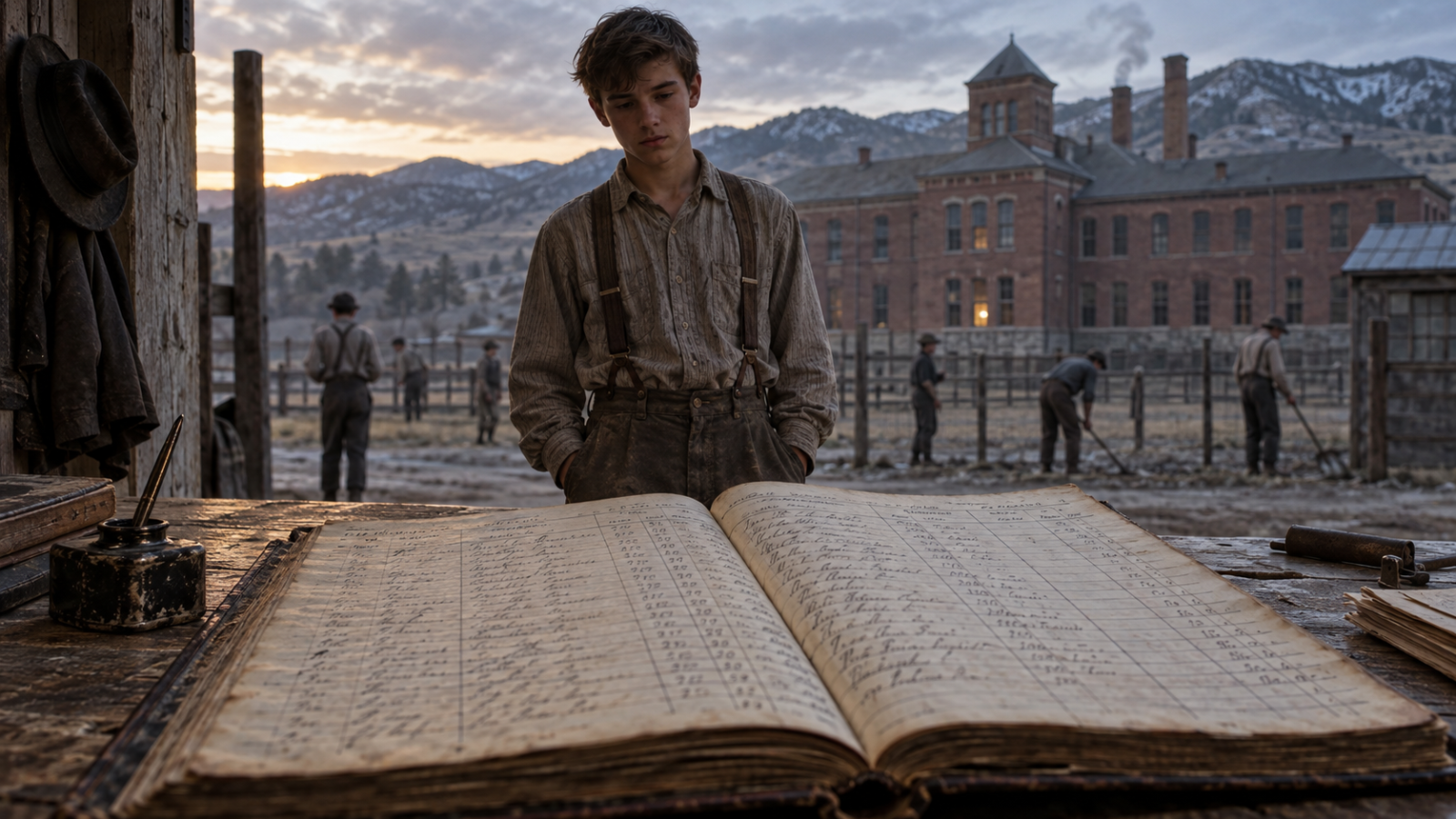
At 5:40 in the morning, before the sun had done much to warm the foothills above Golden, boys at Colorado’s State Industrial School were already awake. What followed was not idle time. Morning drill came first, the kind of marching discipline more familiar from a military post than a classroom, followed by industrial work: shops, farm chores, construction tasks. Afternoons shifted to academic instruction, then recreation on the parade ground, then supper, then chapel. The day ended with chapel, religious observance folded into the schedule alongside everything else.
Boys hauled coal from the train station in Golden. They herded livestock, raked gravel across the parade ground, and dug sewer lines. None of this was separate from their “schooling.” It was the schooling, or at least half of it. Official reports from the school describe a curriculum split between the classroom and the workshop: boys made and mended their own clothes and shoes, did household labor, tended hogs, horses, and cows, raised gardens and hay, kept up repairs, and took part in construction work around the growing campus. Attendance in an actual schoolroom occupied roughly half of a boy’s day. The rest belonged to labor.
It looked, on paper, like a place built to turn boys into workers and citizens. It was also a place that tracked, measured, and recorded nearly everything a boy did, and that record could shape when he left.
Colorado Builds a School at Golden
The Colorado legislature approved the act creating the State Industrial School on February 12, 1881. The institution took shape on a site near Golden later associated with the original Colorado School of Mines building, and it opened later that same year. A working campus grew up around it: a main building with its own dining room and print shop, a tailor shop, a shoe shop, a laundry, a chapel, dormitories, a kitchen and bakery, cottages, a small hospital, a boiler house, a carpenter shop, and a barn.
The staff who ran it wore more than one hat. Records from the period list company commanders who doubled as farmer, teacher, shoemaker, and carpenter, alongside a printing instructor, a band instructor, a tailor, an engineer, a hospital steward, a launderer, a baker, a night watchman, and a man responsible for both policing and the corral. This was not a school with a principal and faculty in the conventional sense. It was closer to a small, self-sufficient town organized around labor, instruction, and supervision, all running on the same clock.
Commitment rules for who ended up there, and for how long, were not fixed across the institution’s history. They changed over time. What official reports consistently show is that boys could be committed to the school’s custody through minority, meaning the school’s authority over a boy could extend well past any single sentence for a single offense. That detail matters because everything that happened next inside the institution, every credit earned and every demerit charged, fed into decisions about when that custody would end.
Freedom by the Ledger
By the 1893-94 reporting period, the school had formalized a system that turned behavior into arithmetic. Boys earned credits. They lost them through demerits, assessed for offenses the rules spelled out in detail: disobedience, disorder, destruction of property, falsehood, fighting, laziness, poor work, profanity, theft, tobacco use, and a category the records call simply “scheming.” Badges, conduct records, and eventually leaves and parole all followed from this accounting. Under the rules in force during that period, five demerits cost a boy one full day of credit.
Running away cost far more. An escape did not just add a mark to a boy’s file. Under the school’s rules, running away wiped out all the credits he had accumulated toward release.
This was the machinery that stood between a committed boy and the outside world, and it was not incidental to daily life at the school. It was daily life. Every chore performed adequately or badly, every incident of temper or defiance, every attempt at “scheming,” entered a ledger that fed directly into whether and when the institution would let a boy go. Reformation, as the school defined it, was not a feeling or a change of heart the staff simply judged by eye. It was a number.
When the Record Followed the Boy
Historian Wade H. Morris, reconstructing one student’s institutional file from the school’s surviving records, uses the pseudonym Andrew Monroe to protect the boy’s identity. Monroe’s case did not involve a single escape but several, and each one entered the same system that governed a boy’s path toward release.
In November 1908, Monroe ran. According to Morris’s reconstruction of the record, he made his way north as far as Laramie, Wyoming, in the depth of winter. He did not come through it unmarked. Frostbite set in, and by Morris’s account it cost Monroe his little finger and three toes, one on his left foot and two on his right.
The physical injury was only part of what that escape cost him. Morris’s analysis of Monroe’s report-card record concludes that his repeated attempts to flee and the negative reports that followed materially delayed his prospects for parole and prolonged his confinement. At the school, an attempted escape could prevent a boy from earning a new badge, cost him badges he had already earned, and extend his confinement by months. For Monroe, those reports accumulated into something even larger: Morris writes that his record, in essence, added years to his incarceration.
Monroe was eventually pardoned in 1912. What the surviving record does not settle is exactly how much longer he remained under the school’s authority because of what appeared in his file rather than because of his original court sentence. But the larger point is clear. For Monroe, the distance between a sentence and freedom was measured in reports, badges, and entries in a file.
Students and Citizens, on Paper
Monroe’s case was one example of a wider pattern of escapes, mutiny, and strikes documented in the school’s records. The school’s own reports document a population under real strain. In the 1899-1900 biennium, the institution took in 200 boys and saw its population climb from 118 to 182, filling cottages and dormitories built for fewer. That same reporting period recorded four scarlet-fever cases and thirteen smallpox cases, with officials openly worried about whether the school had adequate facilities to isolate the sick from the well.
Crowding and disease were only part of the pressure. Peer-reviewed scholarship drawing on the school’s surviving records documents demerits issued for participation in what the records call “mutiny” and “strikes,” alongside a steady stream of running away and escape attempts that never really stopped. By the 1925-26 reporting period, the school had cared for 762 boys, recorded 54 escapes and 19 returned escapees, and granted 382 paroles in the same stretch. Hundreds of boys were paroled, yet escapes remained a persistent part of life at the school.
It was against this backdrop that Superintendent Claude D. Jones reported a deliberate change of course. In 1925-26, Jones described abolishing the old demerit system in favor of a credit system, and he framed the shift in language aimed squarely at the institution’s own history: the goal, he wrote, was to recognize boys as students and citizens, not as prisoners and inmates.
The words were new. What they changed, and for whom, is harder to trace from a single report. A photograph taken December 26, 1928, cataloged by the Denver Public Library, shows a dormitory still packed tight with metal-frame beds, paint peeling from the walls, bare bulbs hanging overhead, and patched sections where windows had been repaired rather than replaced. The picture postdates the new language about students and citizens by only a few years. It does not show what a report can claim, just as a report cannot show what the picture does, leaving the reader to weigh institutional rhetoric against the room it was written about.
A New Name, an Unfinished History
By the mid-1950s, the school’s own reports describe a different institution taking shape inside the old one. The 1955-57 report documents therapeutic counseling, cooperation with University of Colorado students and faculty, referrals for vocational rehabilitation, an indoor gymnasium, a swimming pool, and roughly 753 acres still held by the school. This was a long way from a printing office and a shoe shop measuring demerits by the day.
In 1961, Colorado law formally changed the institution’s name from the State Industrial School for Boys to the Lookout Mountain School for Boys. The site continues to operate today in Golden as the Lookout Mountain Youth Services Center, a secure facility within the Colorado Division of Youth Services for committed adolescent males. The state now describes its approach there as evidence-based, trauma-responsive, restorative, family-engaged, and individualized.
That description sits at a considerable distance from a system in which five demerits cost a boy a day of credit and running away could wipe out everything he had accumulated toward release. The institution changed its language, its programs, and eventually its name. What the record preserves, plainly, is the ledger itself, and the fact that for the boys who lived inside it, freedom was never just a matter of time served. It was a matter of what got written down.
Sources & Further Reading
- Colorado session law establishing the State Industrial School, February 12, 1881
- Colorado School of Mines building history
- State Industrial School biennial report, 1893-94
- State Industrial School biennial report, 1899-1900
- Peer-reviewed scholarship: “The Eye of the Juvenile Court: Report Cards, Juvenile Corrections, and a Colorado Street Kid, 1900-1920”
- State Industrial School biennial report, 1925-26
- Denver Public Library photograph, dormitory interior, December 26, 1928
- State Industrial School biennial report, 1955-57
- Colorado session law renaming the institution Lookout Mountain School for Boys, 1961
- Lookout Mountain Youth Services Center, Colorado Division of Youth Services